 Skip-the-line available
 A History of the Mezquita-Catedral de Córdoba
From the Visigothic basilica of San Vicente through Abd al-Rahman I, the caliphal expansions, the 1236 Reconquista and Charles V's contested Renaissance nave.
Few buildings carry their own history as legibly in their fabric as the Mezquita-Catedral de Córdoba. Begin in the prayer hall and you are standing in a structure begun in 785 CE on the site of a Visigothic church, extended across two centuries by a dynasty of Umayyad rulers, consecrated as a Christian cathedral in 1236, and finally pierced through the middle by a Renaissance nave in the 16th century — without any of those layers being erased. The result is a single building that records the religious history of medieval Iberia more completely than almost any other monument in Europe, which is why UNESCO inscribed it in 1984 as part of the Historic Centre of Córdoba. This guide tells the story in order, from the Roman and Visigothic foundations through the caliphate to Charles V's famous regret.
Roman Temple and Visigothic Basilica
Long before the mosque, the site carried sacred functions. A Roman temple is thought to have stood here in the city of Corduba, and by the mid-6th century a Visigothic Christian basilica dedicated to San Vicente — Saint Vincent — occupied the ground. When the Umayyads took Córdoba in the early 8th century, the Muslim and Christian communities initially shared this basilica for worship, an arrangement recorded in the early sources as the city's population shifted. As the Muslim community grew rapidly and Córdoba rose to become the capital of Al-Andalus, the shared basilica could no longer accommodate Friday prayer, and the decision was taken to build a great congregational mosque on the site. Fragments and reused materials from the earlier Roman and Visigothic structures were incorporated into the new building, which is part of why the prayer hall's columns are such a mixed inheritance of older stone.
Abd al-Rahman I and the First Mosque, 785
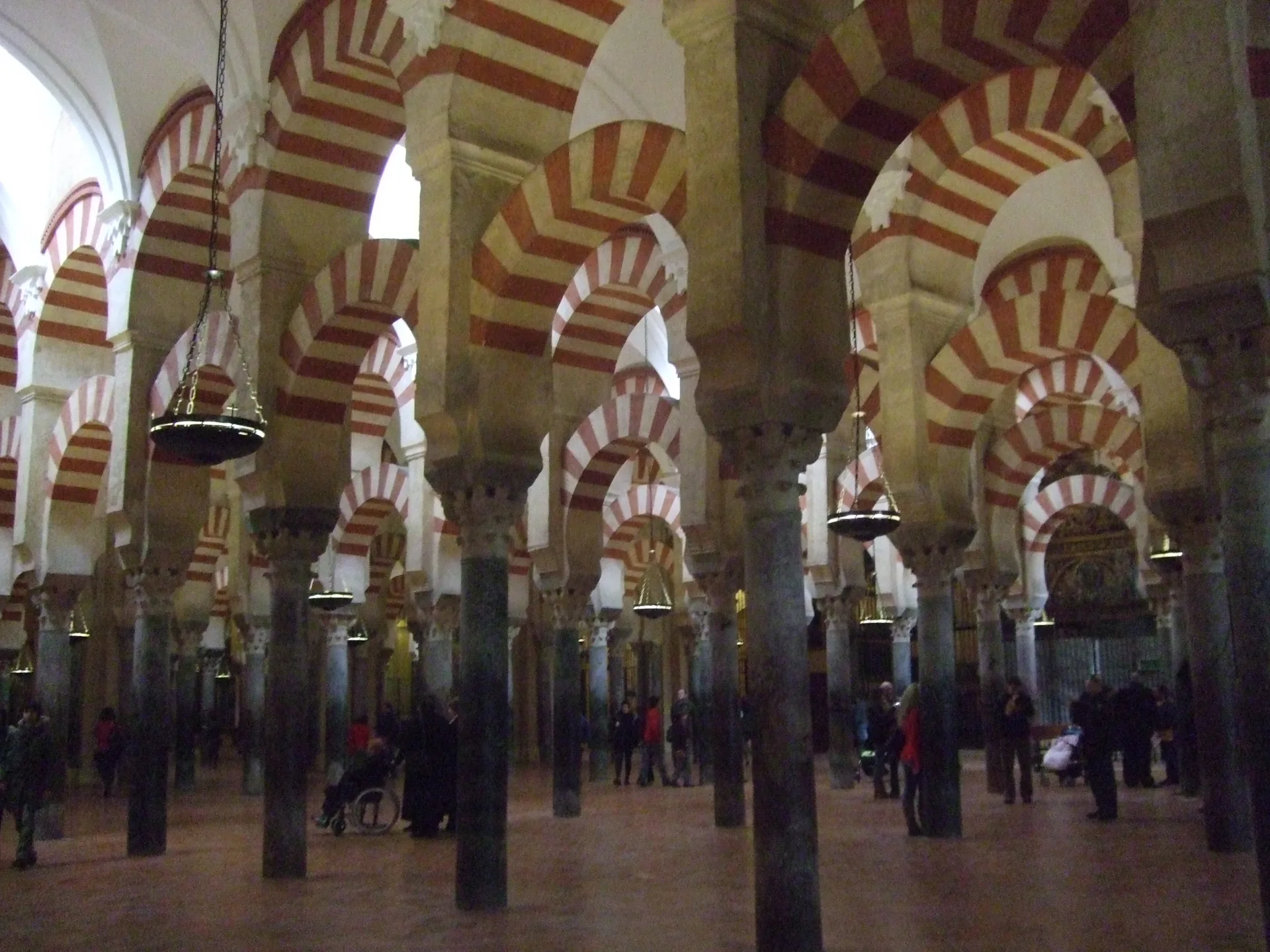
Abd al-Rahman I, the first emir of the independent Umayyad dynasty in Al-Andalus, began construction of the Great Mosque in 785 CE on the remains of the basilica of San Vicente. The project was political as much as religious — a monumental statement of the new emirate's power and permanence in the western edge of the Islamic world. The original mosque already established the building's defining language: a hypostyle prayer hall of parallel naves carried on columns reused from Roman and Visigothic monuments, and the two-tier system of horseshoe arches in alternating red and white that solved the problem of lifting a high roof on relatively short reused shafts. This first phase set the template that every later ruler would extend rather than replace, which is why the building grew enormously over two centuries while remaining visually coherent.
The Caliphal Expansions
Over the following two hundred years the mosque was enlarged in a series of major campaigns. Abd al-Rahman II extended the prayer hall southward in the 9th century to accommodate Córdoba's swelling population. The most artistically significant expansion came under Caliph al-Hakam II around 962–970, who pushed the hall further south and built the lavishly decorated mihrab and maqsura — sending to Byzantine Constantinople for the mosaicists and gold tesserae that still glow in the prayer niche today. This was the high point of the building's Islamic art.
The final and largest Islamic expansion came under al-Mansur (Almanzor), the powerful chief minister, around 987. Because the river blocked further southward growth, al-Mansur extended the mosque eastward instead, adding several naves and substantially completing the orange-tree courtyard, and roughly doubling the building's footprint. By the close of the 10th century the Mezquita had reached its present extent — around 23,400 square metres and 856 columns — making it one of the largest mosques in the world. Every visitor walking the prayer hall today is moving through the accumulated work of these successive rulers, which is legible in subtle shifts of column spacing and decoration between the building campaigns.
1236: Reconquista and Christian Conversion
In 1236 Córdoba fell to the Christian forces of Ferdinand III of Castile during the Reconquista, and the mosque was consecrated as a Catholic cathedral. Crucially, it was not demolished. For nearly three centuries the building functioned as a cathedral with the Islamic prayer hall left largely intact, while successive bishops added small chapels, altars and tombs around the perimeter and beneath al-Hakam II's lantern. The first main chapel, the Capilla de Villaviciosa, was established within the existing Moorish structure rather than by clearing it. This long period of relatively light-touch Christianisation is the reason the mosque's architecture survives at all — for three centuries the building absorbed Christian worship without losing its Umayyad core, a near-unique outcome among the great mosques of reconquered Iberia, most of which were demolished and rebuilt as Gothic cathedrals.
Frequently asked
When was the Mezquita-Catedral de Córdoba built?
The Great Mosque was begun in 785 CE under the Umayyad emir Abd al-Rahman I, on the site of the Visigothic basilica of San Vicente. It was extended by later rulers over two centuries and converted into a Christian cathedral after 1236.
What stood on the site before the mosque?
A Roman temple is thought to have occupied the site in antiquity, and by the mid-6th century a Visigothic Christian basilica dedicated to San Vicente stood there. Muslims and Christians initially shared the basilica before the great mosque was built over it.
Who expanded the Mezquita?
After Abd al-Rahman I's original mosque of 785, the building was enlarged by Abd al-Rahman II in the 9th century, by Caliph al-Hakam II around 962–970 (who built the gold mihrab), and finally by al-Mansur (Almanzor) around 987, who extended it eastward and roughly doubled its size.
When did the mosque become a cathedral?
In 1236, when Córdoba fell to Ferdinand III of Castile during the Reconquista, the mosque was consecrated as a Catholic cathedral. It was not demolished — the Islamic prayer hall remained largely intact while Christian chapels were added around it over the following centuries.
Why did Charles V regret the cathedral nave?
Charles V authorised the insertion of a Renaissance nave into the centre of the mosque in 1523, overruling local opposition. By tradition, on seeing the finished work he told the cathedral chapter they had destroyed something unique in the world to build something that could be found anywhere.
When did the Mezquita become a UNESCO World Heritage Site?
The Mezquita was inscribed by UNESCO in 1984, and the listing was later extended to cover the wider Historic Centre of Córdoba. The designation recognises the building's unique layering of Islamic and Christian architecture across nine centuries.